
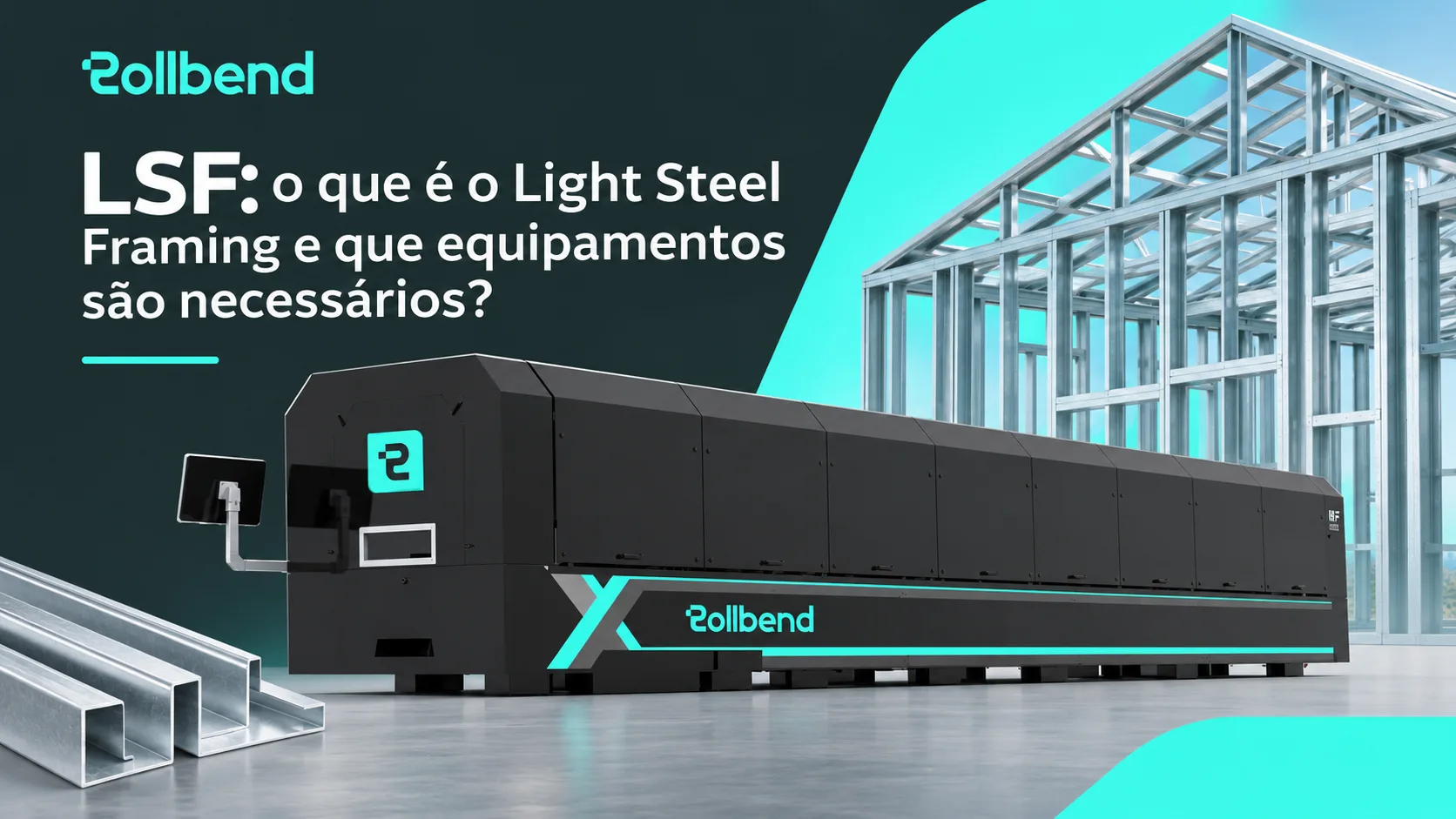
LSF: What Is Light Steel Framing and Which Equipment Is Needed?
LSF (Light Steel Framing) is a construction system that uses lightweight steel profiles to form walls, floors and roof structures. It combines technical design, industrial manufacturing and on-site assembly.
For construction companies, metal structure manufacturers and industrial investors, LSF can offer an opportunity to develop new production capabilities. Before investing, it is important to understand how the system works and which equipment is required to manufacture the profiles.
What Is LSF (Light Steel Framing)?
Light Steel Framing, also known as lightweight steel construction, is a building system based on cold-formed steel profiles, usually made from galvanised steel.
These profiles form the structure of buildings, including walls, floors and roofs. Their geometry and positioning are defined by the structural design.
LSF allows components to be manufactured in an industrial environment and prepared for assembly on the construction site.
Where Is LSF Used?
Light steel framing can be used in different types of projects, depending on the structural design and technical specifications:
- Single-family and multi-family housing;
- Commercial and service buildings;
- Interior partitions and walls;
- Extensions and renovation projects;
- Floors and roofs;
- Modular construction.
Each application must be assessed according to the project, expected loads, materials and applicable standards.
How Does the LSF Construction Process Work?
The process starts with the design and continues through profile manufacturing, component preparation and structural assembly.
1. Design and Profile Specification
The design team defines the structure's geometry, profile types, dimensions, steel thickness and the position of connection elements.
This information is essential to ensure that the manufactured profiles meet the project's requirements.
2. Profile Manufacturing
Profiles are manufactured from steel coils fed into a roll forming line. The machine progressively forms the sheet metal until it reaches the required cross-section.
Depending on the equipment and system configuration, the line may include operations such as punching, marking and cut-to-length processing.
3. Component Preparation and Identification
Profiles can be identified and organised according to the project, making panel preparation and assembly easier.
Organising the components is particularly important when production involves multiple walls, floors or structures with different geometries.
4. On-Site Assembly
The profiles are assembled according to the structural design to form walls, floors or roofs. The structure is then completed with other system components, such as insulation and cladding, according to the specified solution.
What Equipment Is Needed to Manufacture LSF Profiles?
The main equipment required to manufacture profiles for light steel construction is an LSF roll forming machine. The complete line configuration depends on the profiles to be produced, production volume and desired level of automation.
LSF Roll Forming Machine
The roll forming machine transforms sheet metal into a specific cross-section through a sequence of forming rollers.
LSF lines can be configured to manufacture different profile types for walls, floors or roofs. The ability to produce multiple geometries depends on the machine model and available tooling.
Coil Decoiler
The decoiler feeds the steel coil into the production line. Its capacity and type must match the weight, width and characteristics of the material being used.
Punching and Cutting System
Depending on the machine configuration, punching and cutting operations can be integrated into the production process.
These operations allow profiles to be manufactured with holes, notches and project-specific lengths, reducing the need for additional processing.
Design and Production Software
Software is used to prepare manufacturing data from the project and transmit the required instructions to the machine.
Integrating design and production can help organise the manufacturing sequence. Compatibility depends on the software, equipment and workflow being used.
Profile Collection and Handling Table
After forming and cutting, profiles need to be collected and organised.
The output solution may vary depending on profile length, production speed and how the components will be prepared for assembly.
How to Choose an LSF Roll Forming Machine
Not all LSF roll forming machines meet the same requirements. Before choosing equipment, assess your production process and the types of structures you intend to manufacture.
1. Which Profiles Do You Need to Manufacture?
Identify the profiles used in your projects, including geometry, width, thickness, steel type and required operations.
If you plan to manufacture profiles for different applications, check which dimensions and configurations the machine can produce.
2. What Is Your Expected Production Volume?
The required capacity depends on the number of profiles you intend to manufacture and how your production is organised.
A company starting its LSF operation may have different requirements from an industrial facility producing continuously for multiple projects.
3. Which Operations Should Be Integrated?
Assess whether you need punching, cutting, marking or other operations integrated into the line.
The machine configuration should match your production process and profile requirements.
4. How Will the Machine Connect to the Design Process?
Check how design data is prepared and transferred to the machine.
Software compatibility, file formats and the production preparation workflow should be assessed before purchasing.
5. What Technical Support Is Available?
Installation, setup, training and technical assistance are important factors when integrating a new production line.
Discuss these aspects with the supplier before making a decision.
Rollbend LSF Roll Forming Machines: Explore the Available Models
Rollbend offers several roll forming solutions for light steel construction, from equipment designed for specific applications to systems for manufacturing profiles used in walls, floors and roofs.
Visit the Rollbend LSF roll forming machine range to explore the available models and their features.
RB-LS2021
The RB-LS2021 includes Vertex BD software, a servo motor and a 3-ton hydraulic decoiler. The machine generates code directly from the construction design, supporting the connection between design and manufacturing.
RB-LS2025
The RB-LS2025 is a roll forming system for walls, floors and roofs. It works with profiles ranging from 63 to 140 mm, includes 16 forming stations and tooling for operations such as service holes and notches.
RB-MF1400
The RB-MF1400 manufactures C and U profiles from 75 to 140 mm, with steel thicknesses from 0.75 to 1.2 mm. The machine features punching accuracy of ±0.5 mm and automatically adjusts parameters according to the type and thickness of the sheet.
RB-MF1600
The RB-MF1600 manufactures C and U profiles ranging from 75 to 160 mm, with steel thicknesses from 0.75 to 1.6 mm. Its 17 forming stations support applications requiring profile flexibility.
RB-MF2000
The RB-MF2000 manufactures C and U profiles from 75 to 200 mm for walls, floors and roofs. Its dimensional range allows different roll forming requirements to be handled by one machine, depending on the selected configuration.
RB-MF300
The RB-MF300 is a cold roll forming machine with a servo motor, an 11-roller levelling system and hydraulic punching and cutting. It is a compact solution for regular light steel profile production.
RB-MF3005
The RB-MF3005 is designed to manufacture profiles ranging from 89 to 305 mm, with steel thicknesses from 1.0 to 2.5 mm. It includes automatic dimension change via PLC, a 12-metre output table and 19 forming stations.
RB-LG300
The RB-LG300 is dedicated to manufacturing structural floor decking panels. The system includes 13 forming stations, a 22 kW motor and a production speed of up to 35 m/min.
Explore the Rollbend LSF roll forming machines to compare the models and request technical information or a quotation.
How Can Rollbend Help You Choose the Right Solution?
Choosing an LSF roll forming machine starts with understanding what your company intends to manufacture.
The Rollbend team can assess your required profiles, materials, production volume and integration needs to help identify a suitable machine configuration.
Whether you are entering the LSF market, expanding your production capacity or upgrading an existing line, it is worth evaluating your requirements before selecting the equipment.
Looking to Manufacture Light Steel Framing Profiles?
LSF combines structural design, industrial manufacturing and on-site assembly. To manufacture profiles that meet project requirements, it is important to choose a line suited to the required geometries, materials and production volumes.
Are you considering an LSF roll forming machine for your business? Explore the Rollbend LSF range or contact our team to discuss the profiles you intend to manufacture.